
What Epithalon is
Epithalon — also written Epitalon, and referred to by its sequence as the AEDG peptide (Ala-Glu-Asp-Gly) — is a synthetic tetrapeptide. Four residues is unusually short: most of this catalogue runs to dozens, and short peptides are generally assumed to lack the structure needed for specific binding. Epithalon is a counterexample, and much of the research interest follows from that. It was derived from epithalamin, a pineal gland extract, as an attempt to identify the minimal active fragment.
- EpithalonAla-Glu-Asp-Gly tetrapeptide
- Telomerase (TERT) expressionUpregulation reported in cell culture
- Telomere maintenance, pineal regulationAlmost entirely one research group
- Ageing modelsPreclinical; independent replication is thin
Mechanism as described in published research. Nothing here describes an effect in a person — these compounds are supplied for laboratory research use only.
Telomerase and pineal research
The compound appears in two connected literatures. The first concerns telomerase activity — the enzyme that extends telomeric repeats and offsets the shortening that accompanies cell division. Because telomere attrition is one of the better-characterised markers of replicative ageing, anything reported to influence telomerase draws attention, and Epithalon is studied as a probe in that context.
The second concerns pineal regulation and circadian biology, following directly from its origin as a pineal-extract fragment. Work here overlaps with DSIP, which is studied in sleep architecture and circadian models through a separate mechanism.
A note on interpretation: much of the Epithalon literature originates from a narrow group of laboratories, and independent replication is thinner than for compounds like BPC-157 or the incretin analogues. That is a design consideration when planning comparative work.
What the literature covers
Research areas include:
- Telomerase activity in cell-culture models.
- Pineal and circadian regulation, following its derivation from epithalamin.
- Minimal-fragment pharmacology — what a four-residue peptide can and cannot do.
- Ageing biology more broadly, alongside NAD+ and MOTS-c.
Identity and verification
Epithalon has the molecular formula C14H22N4O9 and a molecular weight of 390.35 g/mol (CAS 307297-39-8). Identifiers matter more here than in most categories: research compounds are sold under trade names, development codes and abbreviations that do not always refer to the same molecule, and a formula is unambiguous where a name is not.
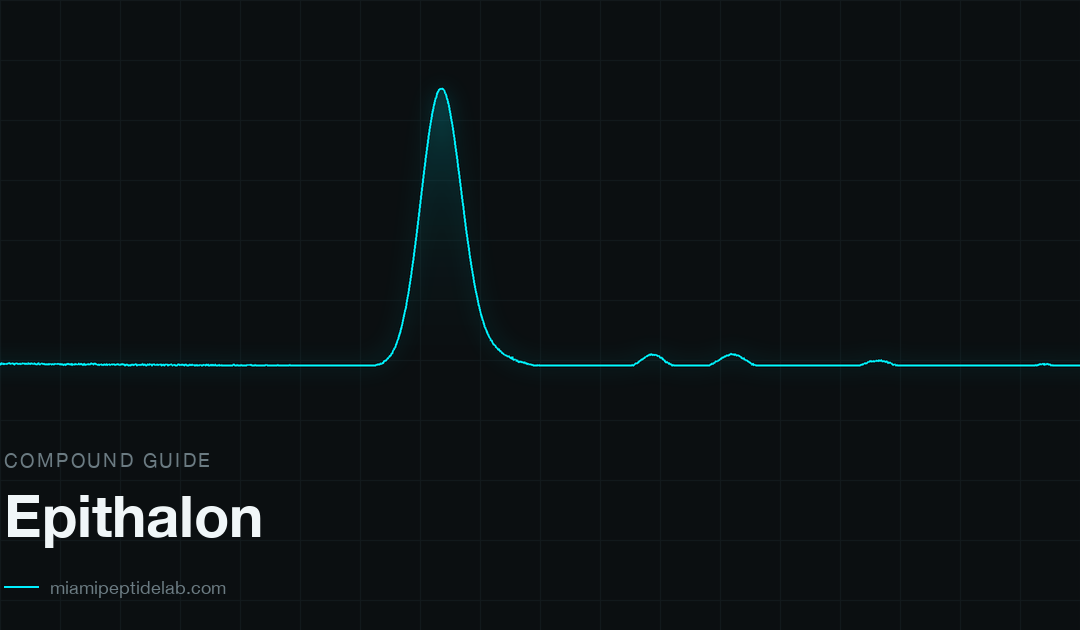
The lot we currently hold measured 99.78% for the 10 mg (lot 261807) and 99.61% for the 50 mg (lot 261807), tested by Freedom Diagnostics. The certificate is published in full, including the raw chromatogram and mass spectrum — so the number can be read off the underlying trace rather than taken on trust.
We use two laboratories because purity and identity are different questions. Vanguard Laboratory is ISO/IEC 17025:2017 accredited (A2LA #6377.01.01) and reports chromatographic purity and net quantity with a stated measurement uncertainty. Freedom Diagnostics reports HPLC-UV purity together with LC-MS identity confirmation — the test that catches a substituted compound rather than merely an impure one. A sample can be 99% pure and still be the wrong molecule. How we test →
Handling, reconstitution and storage
Epithalon ships lyophilized — freeze-dried to a solid and sealed under vacuum — which is what makes it stable in transit rather than a solution racing a clock. Reconstitute with bacteriostatic water, added slowly down the inside wall of the vial rather than directly onto the powder, then swirled gently. Do not shake: mechanical shear is one of the few things that reliably degrades a peptide in the lab.
Final concentration is a function of the volume added, not of the compound, so the same vial can be prepared at very different concentrations. The reconstitution calculator works out the volume for a target concentration and the reconstitution guide covers the procedure. Store lyophilized vials at −20 °C (−4 °F) protected from light; refrigerate once in solution, and see the storage and stability guide for how long reconstituted material holds.
Common questions
Is Epithalon the same as Epitalon?
Yes. Epithalon, Epitalon and the AEDG peptide all refer to the same synthetic tetrapeptide, Ala-Glu-Asp-Gly. Epithalamin refers to the pineal extract it was derived from, which is a different thing.
What does AEDG mean?
It is the single-letter amino acid sequence: Alanine-Glutamate-Aspartate-Glycine. Naming a peptide by its sequence is common where the molecule is short enough for the sequence to be a practical identifier.
Why is a four-residue peptide notable?
Short peptides are generally assumed to lack the structure required for specific binding. Epithalon is studied partly as a counterexample and partly because it was identified as the minimal active fragment of a larger pineal extract.
How well replicated is the Epithalon literature?
Less so than for compounds like BPC-157 or the incretin analogues. Much of it originates from a narrow group of laboratories, which is worth accounting for when designing comparative work.
Where to get it
Buy research-grade Epithalon — independently tested, certificate published, shipped from Miami with cold-chain packaging. Current pricing for every size is on the price list, and we ship worldwide.
Research use only
Everything referenced here is supplied strictly for laboratory research. These compounds are not drugs, foods, cosmetics or medical devices, are not for human or veterinary use, and are not approved for diagnostic or therapeutic application. Mechanisms are described as studied in preclinical and laboratory research; nothing above describes dosing, treatment or clinical outcome.