
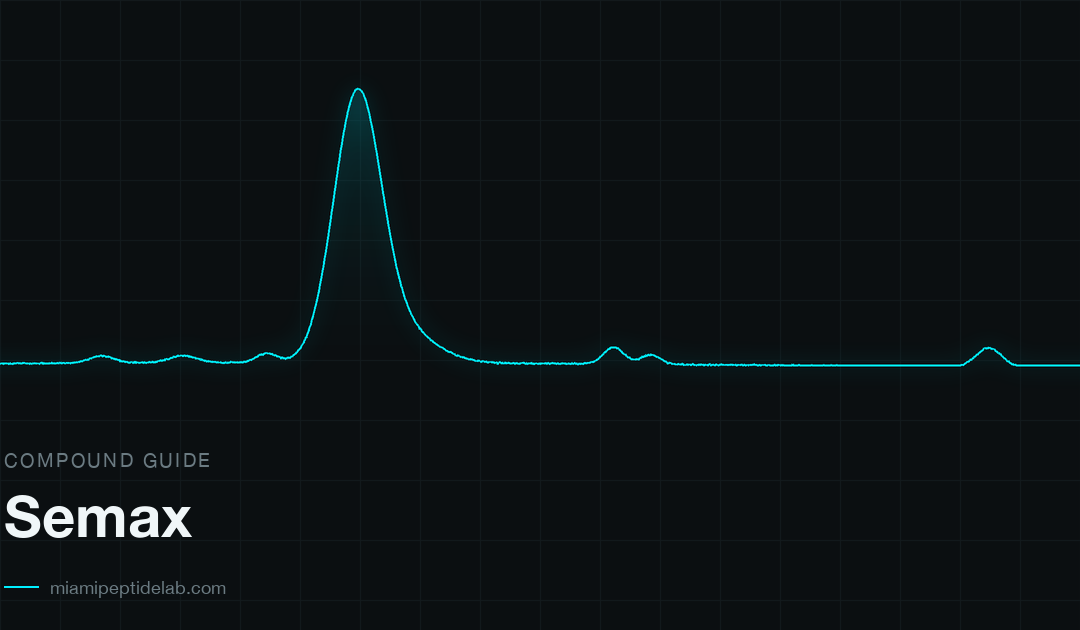
What Semax is
Semax is a synthetic heptapeptide built from the ACTH(4–10) fragment with a Pro-Gly-Pro tail appended. The parent fragment is interesting on its own account: ACTH(4–10) retains behavioural and neurotrophic activity while lacking the corticotropic activity of full ACTH, which means it reaches the central effects without driving the adrenal axis. Semax takes that fragment and makes it stable, the proline-rich tail resisting exopeptidase cleavage in the same way it does in Selank.
- SemaxACTH(4-7) analogue with a Pro-Gly-Pro tail
- BDNF / TrkB expressionUpregulation reported in rodent brain
- Neurotrophic signallingAlso modulates monoamine turnover
- Cognitive and ischaemia modelsLargely Russian clinical literature
Mechanism as described in published research. Nothing here describes an effect in a person — these compounds are supplied for laboratory research use only.
Neurotrophic signalling
The most consistently reported finding in the Semax literature concerns BDNF — brain-derived neurotrophic factor — and its receptor TrkB. BDNF is central to synaptic plasticity and neuronal survival, and is one of the better-characterised endpoints in this area, which is part of why Semax is tractable to study: there is an established assay rather than one that must be validated first.
Work also covers monoamine modulation and, separately, neuroprotection in ischaemia models. As with Selank, a caveat on interpretation: much of the literature originates from a narrow group of laboratories, and independent replication is thinner than for compounds with broader international study.
What the literature covers
Research areas include:
- BDNF and TrkB expression — the primary reported mechanism.
- Neuroprotection models, particularly ischaemia.
- Monoamine system modulation.
- Fragment pharmacology — what ACTH(4–10) retains and what it loses relative to full ACTH.
Identity and verification
Semax has the molecular formula C37H51N9O10S and a molecular weight of 813.9 g/mol (CAS 80714-61-0). Identifiers matter more here than in most categories: research compounds are sold under trade names, development codes and abbreviations that do not always refer to the same molecule, and a formula is unambiguous where a name is not.
Every lot is tested by an independent laboratory before release. Our certificate library covers the lots currently in stock.
We use two laboratories because purity and identity are different questions. Vanguard Laboratory is ISO/IEC 17025:2017 accredited (A2LA #6377.01.01) and reports chromatographic purity and net quantity with a stated measurement uncertainty. Freedom Diagnostics reports HPLC-UV purity together with LC-MS identity confirmation — the test that catches a substituted compound rather than merely an impure one. A sample can be 99% pure and still be the wrong molecule. How we test →
Handling, reconstitution and storage
Semax ships lyophilized — freeze-dried to a solid and sealed under vacuum — which is what makes it stable in transit rather than a solution racing a clock. Reconstitute with bacteriostatic water, added slowly down the inside wall of the vial rather than directly onto the powder, then swirled gently. Do not shake: mechanical shear is one of the few things that reliably degrades a peptide in the lab.
Final concentration is a function of the volume added, not of the compound, so the same vial can be prepared at very different concentrations. The reconstitution calculator works out the volume for a target concentration and the reconstitution guide covers the procedure. Store lyophilized vials at −20 °C (−4 °F) protected from light; refrigerate once in solution, and see the storage and stability guide for how long reconstituted material holds.
Common questions
What is Semax derived from?
The ACTH(4–10) fragment, extended with a Pro-Gly-Pro tail for stability. The fragment retains behavioural and neurotrophic activity without the corticotropic activity of full ACTH.
How does Semax differ from Selank?
Different parent sequences — Semax from an ACTH fragment, Selank from tuftsin — but the same Pro-Gly-Pro stabilising strategy and an overlapping BDNF endpoint. They are usually studied as a comparison pair.
What is N-Acetyl Semax?
An acetylated variant of the same core sequence. Acetylation of the N-terminus is a common stability modification; it is a related but distinct molecule from plain Semax, so certificates and identifiers should be checked against whichever one a protocol calls for.
How well replicated is the Semax literature?
Less broadly than for compounds with wide international study. Much of it originates from a narrow group of laboratories, which is worth accounting for in comparative work.
Where to get it
Buy research-grade Semax — independently tested, certificate published, shipped from Miami with cold-chain packaging. Current pricing for every size is on the price list, and we ship worldwide.
Research use only
Everything referenced here is supplied strictly for laboratory research. These compounds are not drugs, foods, cosmetics or medical devices, are not for human or veterinary use, and are not approved for diagnostic or therapeutic application. Mechanisms are described as studied in preclinical and laboratory research; nothing above describes dosing, treatment or clinical outcome.