
What SS-31 is
SS-31, also called elamipretide or MTP-131, is a synthetic tetrapeptide from the Szeto–Schiller series. Its defining property is that it concentrates in the inner mitochondrial membrane — not by active transport, but through an alternating aromatic-cationic sequence that partitions into that membrane specifically. Getting a molecule to a subcellular compartment reliably is one of the harder problems in this area, and SS-31 solves it structurally rather than with a targeting tag.
- SS-31 (elamipretide)Cell-permeable tetrapeptide
- CardiolipinBinds the inner mitochondrial membrane lipid directly
- Cristae stabilisation → ETC efficiencyReduces electron leak and ROS
- Mitochondrial-function modelsPreclinical and clinical
Mechanism as described in published research. Nothing here describes an effect in a person — these compounds are supplied for laboratory research use only.
Cardiolipin and cristae architecture
Once there, SS-31 associates with cardiolipin, a phospholipid essentially unique to the inner mitochondrial membrane. Cardiolipin is not a passive structural lipid: it organises the cristae folds and is required for the proper assembly and function of the electron transport chain complexes embedded in them. When cardiolipin is disordered, respiratory efficiency falls and electron leak rises.
SS-31 is therefore studied as a probe of that relationship — a way of asking what happens to respiration when cardiolipin organisation is stabilised. That is mechanistically distinct from the other mitochondrial compounds in the catalogue: MOTS-c is a signalling peptide encoded in the mitochondrial genome, and NAD+ is a redox cofactor. Structure, signal and chemistry — three different routes into the same organelle.
What the literature covers
Research areas include:
- Cardiolipin interaction and cristae membrane organisation.
- Electron transport chain efficiency and reactive oxygen species production.
- Mitochondrial dysfunction models across tissue types.
- Subcellular targeting chemistry — how sequence alone achieves compartment selectivity.
Identity and verification
SS-31 has the molecular formula C32H49N9O5 and a molecular weight of 639.8 g/mol (CAS 736992-21-5). Identifiers matter more here than in most categories: research compounds are sold under trade names, development codes and abbreviations that do not always refer to the same molecule, and a formula is unambiguous where a name is not.
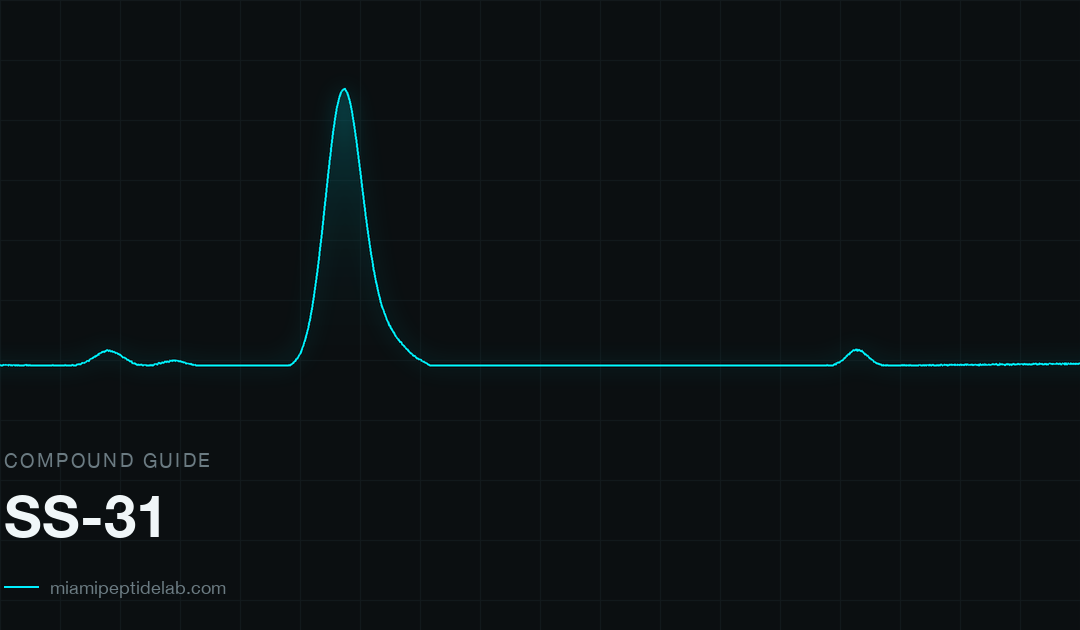
The lot we currently hold measured 98.62% for the 10 mg (lot SS31012), tested by Vanguard Laboratory (ISO 17025 accredited). The certificate is published in full, including the raw chromatogram and mass spectrum — so the number can be read off the underlying trace rather than taken on trust.
We use two laboratories because purity and identity are different questions. Vanguard Laboratory is ISO/IEC 17025:2017 accredited (A2LA #6377.01.01) and reports chromatographic purity and net quantity with a stated measurement uncertainty. Freedom Diagnostics reports HPLC-UV purity together with LC-MS identity confirmation — the test that catches a substituted compound rather than merely an impure one. A sample can be 99% pure and still be the wrong molecule. How we test →
Handling, reconstitution and storage
SS-31 ships lyophilized — freeze-dried to a solid and sealed under vacuum — which is what makes it stable in transit rather than a solution racing a clock. Reconstitute with bacteriostatic water, added slowly down the inside wall of the vial rather than directly onto the powder, then swirled gently. Do not shake: mechanical shear is one of the few things that reliably degrades a peptide in the lab.
Final concentration is a function of the volume added, not of the compound, so the same vial can be prepared at very different concentrations. The reconstitution calculator works out the volume for a target concentration and the reconstitution guide covers the procedure. Store lyophilized vials at −20 °C (−4 °F) protected from light; refrigerate once in solution, and see the storage and stability guide for how long reconstituted material holds.
Common questions
Is SS-31 the same as elamipretide?
Yes. SS-31, elamipretide and MTP-131 refer to the same synthetic tetrapeptide from the Szeto–Schiller series.
How does SS-31 reach the mitochondrion?
Through its own structure rather than a targeting tag. An alternating aromatic-cationic sequence causes it to partition into the inner mitochondrial membrane specifically.
What is cardiolipin and why does it matter?
A phospholipid essentially unique to the inner mitochondrial membrane. It organises the cristae folds and is required for proper assembly of the electron transport chain complexes, so its organisation directly affects respiratory efficiency.
How does SS-31 differ from MOTS-c and NAD+?
All three concern the mitochondrion by different routes: SS-31 addresses membrane structure, MOTS-c is a signalling peptide encoded in the mitochondrial genome, and NAD+ is a redox cofactor.
Where to get it
Buy research-grade SS-31 — independently tested, certificate published, shipped from Miami with cold-chain packaging. Current pricing for every size is on the price list, and we ship worldwide.
Research use only
Everything referenced here is supplied strictly for laboratory research. These compounds are not drugs, foods, cosmetics or medical devices, are not for human or veterinary use, and are not approved for diagnostic or therapeutic application. Mechanisms are described as studied in preclinical and laboratory research; nothing above describes dosing, treatment or clinical outcome.