
What PT-141 is
PT-141, also called bremelanotide, is a cyclic heptapeptide derived from a metabolite of Melanotan-2. That derivation is the whole story of the molecule: researchers working with Melanotan-2 observed that one of its breakdown products retained receptor activity while losing the pigmentation-associated component, and PT-141 is that fragment developed deliberately.
- PT-141 (bremelanotide)Melanotan-2 metabolite
- MC4R, MC3RSelective for MC4R over MC1R — the key difference from MT-2
- CNS melanocortin signallingHypothalamic rather than peripheral
- Behavioural modelsPreclinical and clinical
Mechanism as described in published research. Nothing here describes an effect in a person — these compounds are supplied for laboratory research use only.
Receptor selectivity
Where Melanotan-2 is a broadly non-selective melanocortin agonist, PT-141 shows a relative preference for MC3R and MC4R over the MC1R activity associated with pigmentation. In research terms this is what makes it valuable: it allows the MC3R/MC4R arm of melanocortin signalling to be probed without the pigmentation response acting as a confounder or a visible marker.
The pair is therefore a useful natural experiment. Running Melanotan-2 and PT-141 side by side in the same model isolates what the MC1R arm contributes, because the two molecules are structurally close and differ principally in selectivity rather than in class.
What the literature covers
Research areas include:
- MC3R/MC4R pharmacology — binding, potency and downstream signalling.
- Central versus peripheral action — melanocortin signalling in the central nervous system rather than at peripheral melanocytes.
- Sexual-function research models, the area in which it is most published.
- Selectivity engineering — as a case study in deriving a selective analogue from a non-selective parent.
Kisspeptin-10 and oxytocin act on separate systems and are often examined in adjacent study designs.
Identity and verification
PT-141 has the molecular formula C50H68N14O10 and a molecular weight of 1025.2 g/mol (CAS 189691-06-3). Identifiers matter more here than in most categories: research compounds are sold under trade names, development codes and abbreviations that do not always refer to the same molecule, and a formula is unambiguous where a name is not.
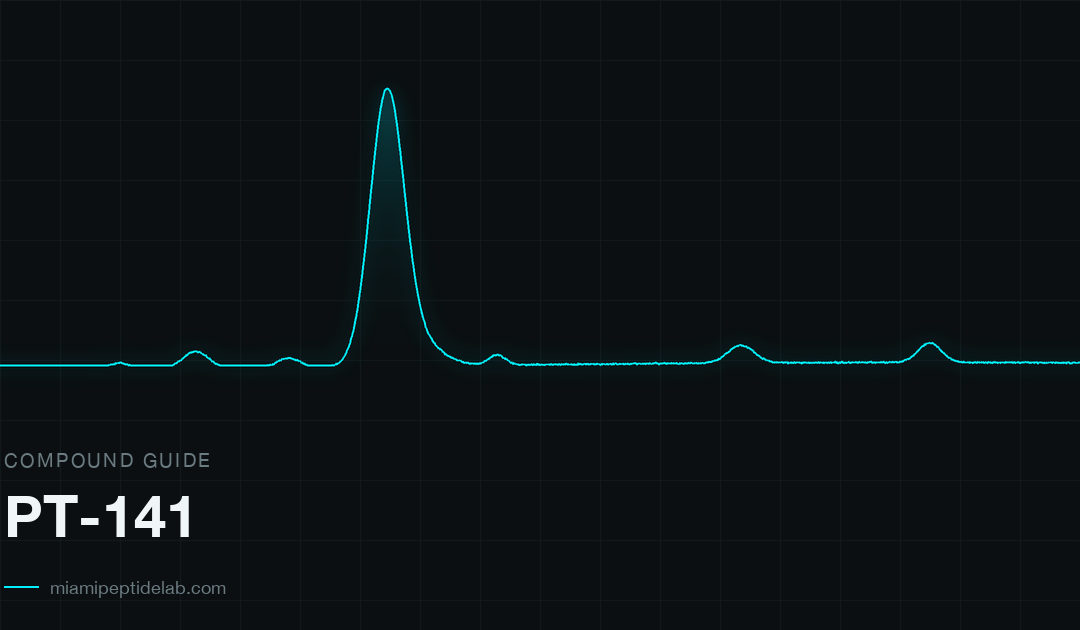
The lot we currently hold measured 99.74% for the 10 mg (lot 261807), tested by Freedom Diagnostics. The certificate is published in full, including the raw chromatogram and mass spectrum — so the number can be read off the underlying trace rather than taken on trust.
We use two laboratories because purity and identity are different questions. Vanguard Laboratory is ISO/IEC 17025:2017 accredited (A2LA #6377.01.01) and reports chromatographic purity and net quantity with a stated measurement uncertainty. Freedom Diagnostics reports HPLC-UV purity together with LC-MS identity confirmation — the test that catches a substituted compound rather than merely an impure one. A sample can be 99% pure and still be the wrong molecule. How we test →
Handling, reconstitution and storage
PT-141 ships lyophilized — freeze-dried to a solid and sealed under vacuum — which is what makes it stable in transit rather than a solution racing a clock. Reconstitute with bacteriostatic water, added slowly down the inside wall of the vial rather than directly onto the powder, then swirled gently. Do not shake: mechanical shear is one of the few things that reliably degrades a peptide in the lab.
Final concentration is a function of the volume added, not of the compound, so the same vial can be prepared at very different concentrations. The reconstitution calculator works out the volume for a target concentration and the reconstitution guide covers the procedure. Store lyophilized vials at −20 °C (−4 °F) protected from light; refrigerate once in solution, and see the storage and stability guide for how long reconstituted material holds.
Common questions
Is PT-141 the same as bremelanotide?
Yes. PT-141 and bremelanotide refer to the same cyclic heptapeptide; the two names are used interchangeably in vendor listings and literature.
How is PT-141 related to Melanotan-2?
It is derived from a Melanotan-2 metabolite. Researchers observed that one breakdown product retained melanocortin receptor activity while losing the pigmentation-associated component, and PT-141 is that fragment developed deliberately.
Why is receptor selectivity useful here?
Melanotan-2 activates most melanocortin receptors including MC1R, which drives pigmentation. PT-141 favours MC3R and MC4R, so the central arm of melanocortin signalling can be studied without the pigmentation response confounding the result.
Why are PT-141 and Melanotan-2 studied together?
Because they are structurally close and differ principally in selectivity. Running both in the same model isolates what the MC1R arm specifically contributes.
Where to get it
Buy research-grade PT-141 — independently tested, certificate published, shipped from Miami with cold-chain packaging. Current pricing for every size is on the price list, and we ship worldwide.
Research use only
Everything referenced here is supplied strictly for laboratory research. These compounds are not drugs, foods, cosmetics or medical devices, are not for human or veterinary use, and are not approved for diagnostic or therapeutic application. Mechanisms are described as studied in preclinical and laboratory research; nothing above describes dosing, treatment or clinical outcome.