
What GHK-Cu is
GHK-Cu is a copper-binding tripeptide — glycyl-L-histidyl-L-lysine — bound to a copper(II) ion. The peptide itself was isolated from human plasma in 1973, where its concentration falls with age, and it binds Cu²⁺ with an affinity high enough to carry the ion but low enough to hand it off to the enzymes that need it. That transfer is the whole point of the molecule: GHK on its own and copper on its own do not reproduce what the complex does.
It is studied as a signalling molecule rather than a structural one. The literature on it is unusually broad for a tripeptide, covering copper transport, extracellular matrix turnover and a wide set of transcriptional effects — and unusually old, which means there is more of it than for most compounds in this category.
- GHK-CuGly-His-Lys tripeptide, copper(II) complex
- Cu²⁺ delivery to enzymesLysyl oxidase, superoxide dismutase
- Gene expression → collagen, MMP balanceBroad transcriptional effects reported
- ECM remodelling modelsCell culture and animal studies
Mechanism as described in published research. Nothing here describes an effect in a person — these compounds are supplied for laboratory research use only.
Why the copper matters
GHK-Cu is the tripeptide glycyl-L-histidyl-L-lysine bound to a copper(II) ion, and the copper is not incidental. GHK on its own is a three-residue peptide of modest interest; the complex is a copper transport molecule, and most of the reported biology follows from that. Copper is required as a cofactor by lysyl oxidase, superoxide dismutase and other enzymes, but free copper ions are reactive and damaging, so biology moves copper around bound to carriers. GHK is one such carrier.
This article covers the coordination chemistry and matrix biology. For the general research overview see what GHK-Cu is.
Extracellular matrix remodelling
The most substantial GHK-Cu literature concerns the extracellular matrix — collagen, elastin and the proteoglycans between cells. Reported effects run in both directions: increased synthesis of matrix components, and modulation of the metalloproteinases that break them down. A molecule reported to influence both sides of a turnover process is described as a remodelling agent rather than a stimulant, and that framing is worth preserving in study design.
A separate strand examines gene expression more broadly, with transcriptomic work reporting changes across large numbers of genes. Results of that kind need care: broad expression changes are easy to generate and hard to attribute. GHK-Cu is co-studied with BPC-157 and TB-500 in repair models, and appears in the GLOW and KLOW blends.
What the literature covers
Research areas include:
- Copper coordination chemistry and carrier function.
- Collagen and elastin synthesis, and metalloproteinase modulation.
- Transcriptomic studies of broad gene-expression change.
- Skin and connective-tissue models, the largest applied literature.
Identity and verification
GHK-Cu has the molecular formula C14H21CuN6O4- and a molecular weight of 400.90 g/mol. Identifiers matter more here than in most categories: research compounds are sold under trade names, development codes and abbreviations that do not always refer to the same molecule, and a formula is unambiguous where a name is not.
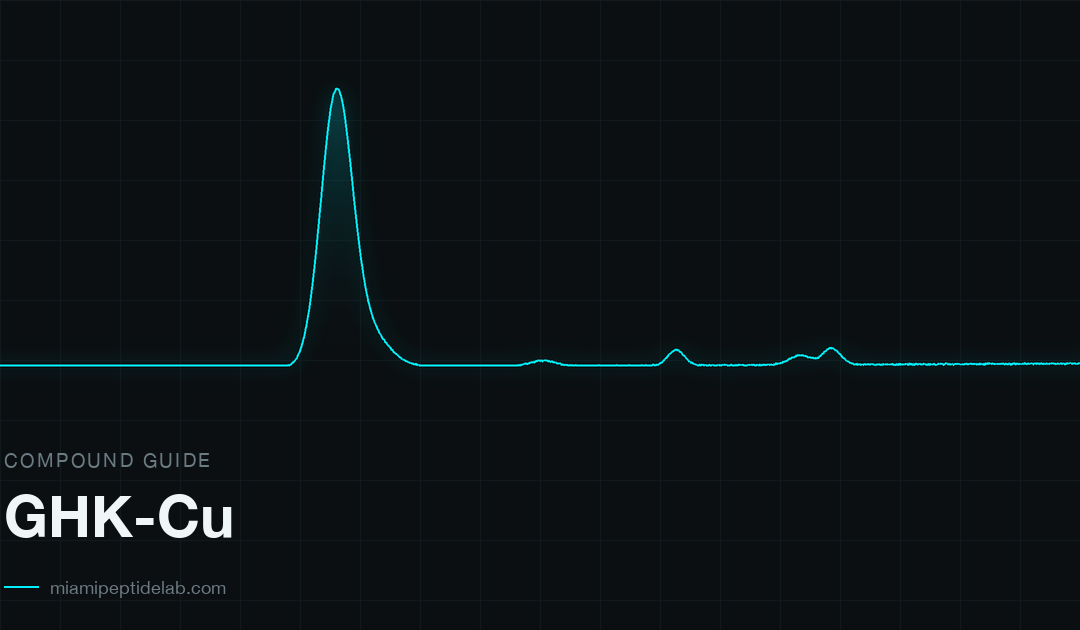
The lot we currently hold measured 99.80% for the 50 mg (lot GHKCU012), tested by Vanguard Laboratory (ISO 17025 accredited). The certificate is published in full, including the raw chromatogram and mass spectrum — so the number can be read off the underlying trace rather than taken on trust.
We use two laboratories because purity and identity are different questions. Vanguard Laboratory is ISO/IEC 17025:2017 accredited (A2LA #6377.01.01) and reports chromatographic purity and net quantity with a stated measurement uncertainty. Freedom Diagnostics reports HPLC-UV purity together with LC-MS identity confirmation — the test that catches a substituted compound rather than merely an impure one. A sample can be 99% pure and still be the wrong molecule. How we test →
Handling, reconstitution and storage
GHK-Cu ships lyophilized — freeze-dried to a solid and sealed under vacuum — which is what makes it stable in transit rather than a solution racing a clock. Reconstitute with bacteriostatic water, added slowly down the inside wall of the vial rather than directly onto the powder, then swirled gently. Do not shake: mechanical shear is one of the few things that reliably degrades a peptide in the lab.
Final concentration is a function of the volume added, not of the compound, so the same vial can be prepared at very different concentrations. The reconstitution calculator works out the volume for a target concentration and the reconstitution guide covers the procedure. Store lyophilized vials at −20 °C (−4 °F) protected from light; refrigerate once in solution, and see the storage and stability guide for how long reconstituted material holds.
Common questions
Why is GHK bound to copper?
Because the complex is a copper transport molecule, and most of the reported biology follows from that. Copper is a required enzyme cofactor but damaging as a free ion, so biology moves it bound to carriers — GHK is one.
Is GHK-Cu the same as copper peptide?
"Copper peptide" is a general term; GHK-Cu, also called copper tripeptide-1, is the specific and most-studied example.
Does GHK-Cu build or break down matrix?
The literature reports effects in both directions — increased synthesis of matrix components and modulation of the metalloproteinases that degrade them. It is more accurately described as a remodelling agent than a stimulant.
How should transcriptomic findings be read?
Carefully. Broad gene-expression changes are comparatively easy to generate and difficult to attribute to a specific mechanism, so they support hypotheses rather than settle them.
Where to get it
Buy research-grade GHK-Cu — independently tested, certificate published, shipped from Miami with cold-chain packaging. Current pricing for every size is on the price list, and we ship worldwide.
Research use only
Everything referenced here is supplied strictly for laboratory research. These compounds are not drugs, foods, cosmetics or medical devices, are not for human or veterinary use, and are not approved for diagnostic or therapeutic application. Mechanisms are described as studied in preclinical and laboratory research; nothing above describes dosing, treatment or clinical outcome.