
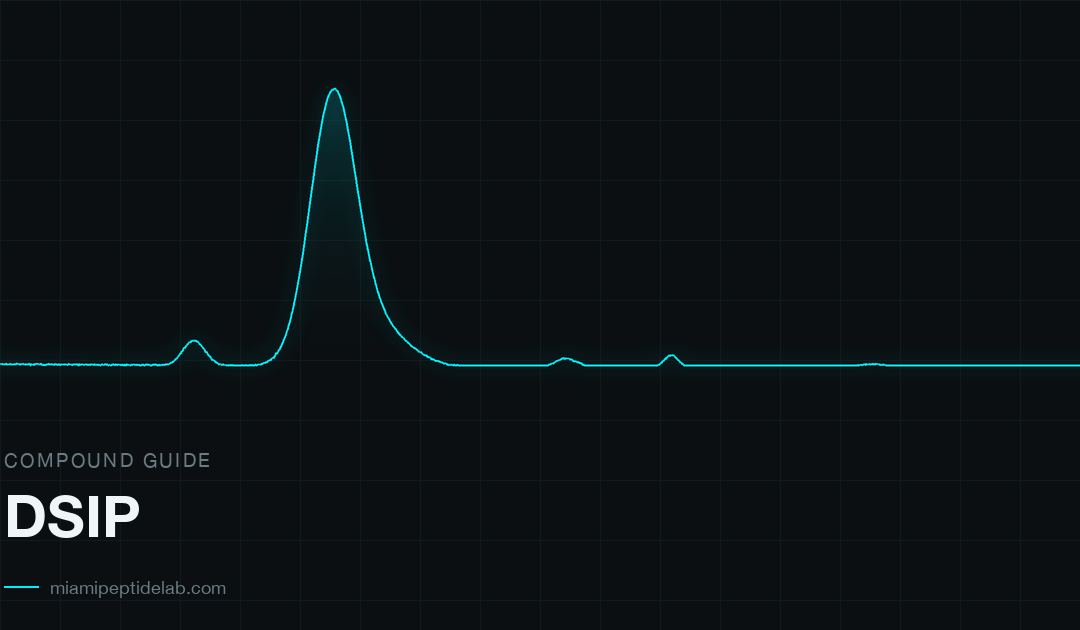
What DSIP is
Delta sleep-inducing peptide is a nonapeptide first isolated in the 1970s from cerebral venous blood during induced sleep. The name records what it was observed to do rather than how it does it, and half a century later that remains the honest position: DSIP has no confirmed receptor.
That is genuinely unusual for a compound this well known, and it is worth stating plainly rather than glossing. Most peptides in this catalogue have an identified target and a characterised pathway. DSIP has a reproducible name, a defined sequence, and an open mechanistic question — which is precisely why it continues to appear in the literature.
- DSIPDelta sleep-inducing peptide, nonapeptide
- No receptor identifiedThe honest state of the evidence
- Correlated with delta-wave activityMechanism unestablished after five decades
- Sleep-architecture modelsFindings inconsistent between groups
Mechanism as described in published research. Nothing here describes an effect in a person — these compounds are supplied for laboratory research use only.
Sleep and circadian research
Work with DSIP concentrates on sleep architecture — specifically delta-wave or slow-wave activity, the deepest stage of non-REM sleep, which is where the original observation came from. Reported effects across studies are inconsistent, and a considerable part of the literature is concerned with why: differences in model, timing, and preparation all appear to matter.
A second strand treats it as a broader regulatory peptide, examining circadian and stress-response endpoints. Epithalon, with its pineal derivation, is studied in adjacent circadian contexts through an entirely different route.
What the literature covers
Research areas include:
- Slow-wave sleep architecture in animal and EEG models.
- Circadian and stress-response regulation.
- Mechanistic search — ongoing work on receptor identification.
- Reproducibility analysis — why reported effects vary between studies.
Identity and verification
DSIP has the molecular formula C35H48N10O15 and a molecular weight of 848.8 g/mol (CAS 62568-57-4). Identifiers matter more here than in most categories: research compounds are sold under trade names, development codes and abbreviations that do not always refer to the same molecule, and a formula is unambiguous where a name is not.
The lot we currently hold measured 99.43% for the 10 mg (lot 261807), tested by Freedom Diagnostics. The certificate is published in full, including the raw chromatogram and mass spectrum — so the number can be read off the underlying trace rather than taken on trust.
We use two laboratories because purity and identity are different questions. Vanguard Laboratory is ISO/IEC 17025:2017 accredited (A2LA #6377.01.01) and reports chromatographic purity and net quantity with a stated measurement uncertainty. Freedom Diagnostics reports HPLC-UV purity together with LC-MS identity confirmation — the test that catches a substituted compound rather than merely an impure one. A sample can be 99% pure and still be the wrong molecule. How we test →
Handling, reconstitution and storage
DSIP ships lyophilized — freeze-dried to a solid and sealed under vacuum — which is what makes it stable in transit rather than a solution racing a clock. Reconstitute with bacteriostatic water, added slowly down the inside wall of the vial rather than directly onto the powder, then swirled gently. Do not shake: mechanical shear is one of the few things that reliably degrades a peptide in the lab.
Final concentration is a function of the volume added, not of the compound, so the same vial can be prepared at very different concentrations. The reconstitution calculator works out the volume for a target concentration and the reconstitution guide covers the procedure. Store lyophilized vials at −20 °C (−4 °F) protected from light; refrigerate once in solution, and see the storage and stability guide for how long reconstituted material holds.
Common questions
What does DSIP stand for?
Delta sleep-inducing peptide. The name records the observation it was named for — delta-wave sleep activity — rather than a mechanism.
What receptor does DSIP act on?
None confirmed. Despite being identified in the 1970s and studied since, DSIP has no established receptor, which is unusual for a compound this well known and is part of why it remains an active research subject.
Why are DSIP results inconsistent between studies?
A substantial part of the literature is concerned with exactly that question. Differences in model, timing and preparation all appear to contribute, and the absence of a known receptor makes the variability harder to account for.
What is DSIP studied alongside?
Epithalon is examined in adjacent circadian contexts, arriving there through pineal regulation rather than sleep architecture.
Where to get it
Buy research-grade DSIP — independently tested, certificate published, shipped from Miami with cold-chain packaging. Current pricing for every size is on the price list, and we ship worldwide.
Research use only
Everything referenced here is supplied strictly for laboratory research. These compounds are not drugs, foods, cosmetics or medical devices, are not for human or veterinary use, and are not approved for diagnostic or therapeutic application. Mechanisms are described as studied in preclinical and laboratory research; nothing above describes dosing, treatment or clinical outcome.