
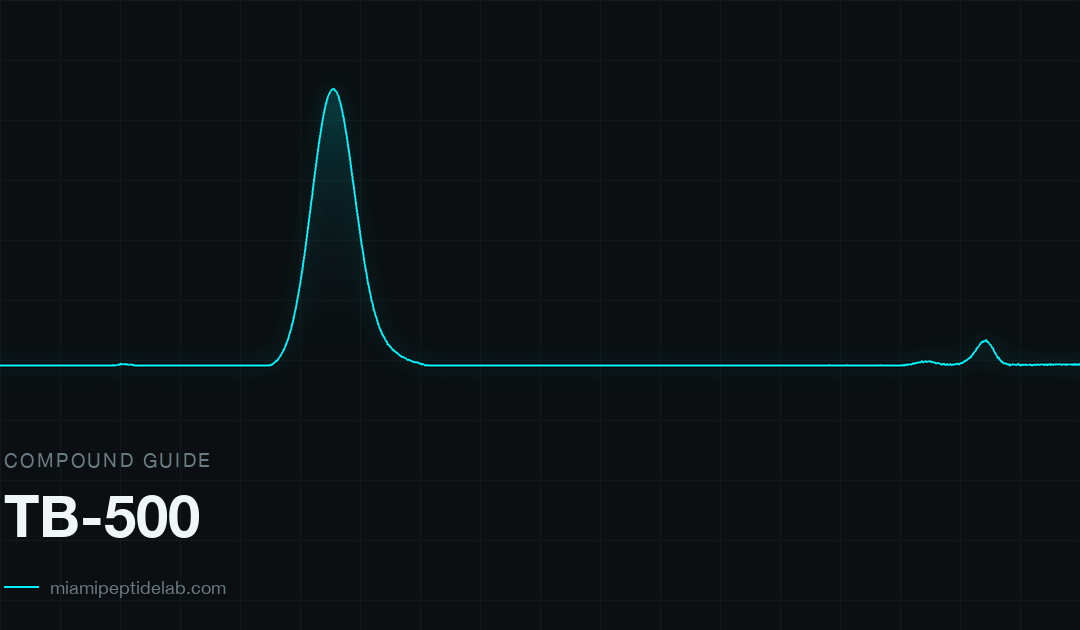
TB-500 is a synthetic fragment of thymosin beta-4 studied in tissue-repair, cell-migration, and angiogenesis research — and one of the peptides most often paired with BPC-157.
What is TB-500?
TB-500 is a synthetic peptide that corresponds to the biologically active region of thymosin beta-4 (Tβ4), a naturally occurring actin-binding protein. Rather than the full 43-amino-acid Tβ4 protein, TB-500 represents the key active fragment, which makes it a practical, stable research analog of the parent molecule.
- TB-500Ac-LKKTETQ, an active thymosin β4 fragment
- G-actinSequesters monomeric actin
- Actin polymerisation → cell migrationCytoskeletal remodelling
- Wound-repair modelsPreclinical
Mechanism as described in published research. Nothing here describes an effect in a person — these compounds are supplied for laboratory research use only.
Structure & background
Thymosin beta-4 is one of the most abundant actin-sequestering proteins in cells and plays a role in cytoskeletal regulation. Research on TB-500 centers on the fragment containing the actin-binding motif (often associated with the LKKTETQ sequence region), which is thought to carry much of Tβ4’s cell-migration activity in models.
What TB-500 is studied for
In laboratory and animal models, TB-500 is investigated for:
- Actin regulation and cell migration — the core of thymosin beta-4 biology.
- Tissue-repair and wound models.
- Angiogenesis — new blood-vessel formation.
- Cardiac and other recovery research models.
Half-life & forms
Compared with BPC-157, TB-500 is associated with a longer research half-life, which is reflected in the study protocols that use it. It is supplied as a lyophilized powder.
TB-500 vs BPC-157
The two are the classic recovery-research pairing. BPC-157 is a gastric-derived pentadecapeptide; TB-500 is a thymosin beta-4 fragment — different origins, frequently co-studied. See the full BPC-157 vs TB-500 comparison, or the BPC-157 + TB-500 blend.
Reconstitution, handling & storage
TB-500 ships lyophilized and is reconstituted with bacteriostatic water. See the reconstitution guide, calculator, and storage guide. Category: healing & recovery peptides.
Frequently asked questions
What is TB-500?
TB-500 is a synthetic fragment of thymosin beta-4, a naturally occurring actin-binding protein. It is studied in tissue-repair, cell-migration, and angiogenesis research.
TB-500 vs BPC-157 — what is the difference?
They come from different sources — BPC-157 is a gastric-derived pentadecapeptide, TB-500 is a thymosin beta-4 fragment — and are frequently co-studied in recovery research. See our full comparison.
What is TB-500 studied for?
In animal and laboratory models it is investigated for actin regulation, cell migration, tissue repair, and angiogenesis. These are research directions, not human outcomes.
How is TB-500 reconstituted?
It ships as a lyophilized powder and is reconstituted with bacteriostatic water, then refrigerated. See our reconstitution guide and calculator.
Is TB-500 lab-tested?
Yes — every lot is lab-tested to a 99%+ purity standard with a batch-specific Certificate of Analysis published in full.
Why researchers order from Miami Peptide Lab
- Independently tested every lot — the batch Certificate of Analysis is published in full, free to read.
- Ships from Miami and across the US in 24–48 business hours with tracking, in discreet cold-chain packaging.
- Buy-more-save-more bundle pricing on every vial, plus a reship-or-refund guarantee.
Research use only
All products referenced here are sold strictly for laboratory and research use. They are not intended for human or animal consumption, nor for any therapeutic, diagnostic, or cosmetic use, and must be handled only by qualified professionals in an appropriate research setting.