
A Certificate of Analysis (COA) is the lab document that verifies what is actually in a peptide vial. Learning to read one is the single best way to evaluate a research-peptide source.
What a COA shows
- Identity — confirmation the compound is what the label says, typically via mass spectrometry (MS).
- Purity — the percentage of the target compound, usually by high-performance liquid chromatography (HPLC).
- Batch / lot number — ties the result to the specific vial you received.
- Test date and method — when and how it was analyzed.
HPLC and MS explained
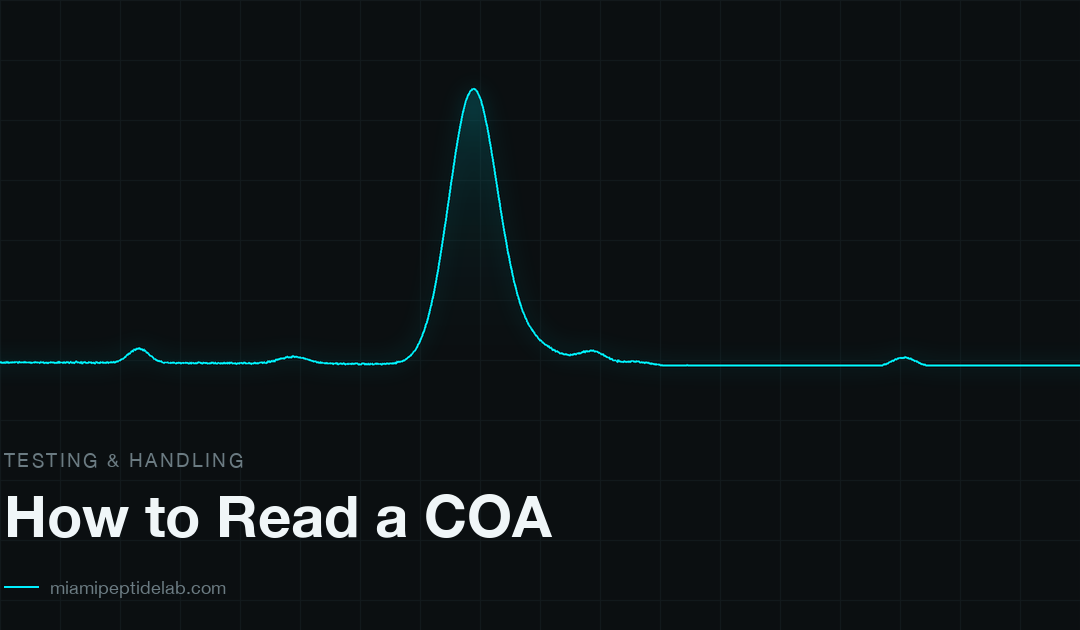
HPLC separates the sample so any impurities show up as additional peaks — a high, clean main peak indicates high purity. MS confirms the molecular weight matches the intended peptide, verifying identity. Together they answer the two questions that matter: is it the right compound, and how pure is it?
Reading the purity figure
Purity is reported as a percentage of total peak area. A 99%+ figure means the target compound accounts for at least 99% of what the HPLC detected. Always check that the lot number on the COA matches the vial, and that the test date is recent relative to the batch.
Our standard
Every Miami Peptide Lab lot is lab-tested to a 99%+ purity standard, and a batch-specific Certificate of Analysis is published in full for any product. Learn more on The Science page, or request a COA.
Research use only
All products referenced here are sold strictly for laboratory and research use. They are not intended for human or animal consumption, nor for any therapeutic, diagnostic, or cosmetic use, and must be handled only by qualified professionals in an appropriate research setting.